My days at the Lower Windrush Valley Project are rarely routine and Wednesday 25th September was no exception. I spent the morning with the volunteer group at Standlake Common Nature Reserve coppicing hazel to provide stakes and binders for the hedgelayers to use the following week. It is always satisfying to be able to use our home grown produce for projects. It was also the first time that Louise had done coppicing and she quickly developed an eye for it and a good technique.
Then it was time for an hour at my desk and a quick change before I headed up to London for an evening reception to celebrate the work of RESTORE; a new European funded partnership, headed by the RSPB set up to restore mineral sites for biodiversity, people and the economy across North West Europe. Surrey County Council and organisations from Belgium, Holland and Germany are the other partners. The project began in 2012 and runs to 2015 and can already showcase some very positive restoration sites with a view to influencing future practice.
The speakers were all very interesting and although I haven't the time to cover them all the following three made a big impression on me as they related to specific aspects of our work at the LWVP. Sue Armstrong-Brown, head of Conservation Policy at the RSPB, highlighted how many targets for the maintenance and improvement of threatened habitats and species are already being delivered on these sites and their huge potential for the future. She also talked about how important many of these sites are for people, for their recreation and enjoyment of the natural world.
Nigel Jackson, Chief Executive of the Mineral Products Association was very positive about the willingness and, in many cases, the enthusiasm of the minerals operators to engage with the highest standard of restoration to secure maximum benefit for wildlife. He also said how much he regrets the loss of the Aggregates Levy Sustainable Fund Grant Scheme that was such a good resource for many environmental projects and enabled some really useful work to be done here in the valley. He has written to the minister to express his frustration about this.
Even the MEP Catherine Bearder had some pertinent points to make. Apparently she is known as the 'Bees and Elephants MEP' as she is always trying to include her passion and concern for the environment in whatever portfolio she is working on. She said how even at that level people's eyes glaze over at the mention of 'biodiversity'. They don't understand the concepts or the issues and how important care for the environment is for the future of our everyday lives. There is clearly a great need for more environmental education which is an aspect of the LWVP that I hope to develop in the future.
On the train on the way home it was time to reflect on the threads that connect these top policy makers with those who prefer to make local efforts to improve biodiversity on the ground. This was an international celebration of the work that is going on around us in the Lower Windrush Valley ranging from the companies like Smiths Bletchington that want to leave a positive legacy for the future to the individual volunteers like Louise who want to do their bit to make a difference.
Thursday, 3 October 2013
Monday, 23 September 2013
Sluice replaced
Talk to people about replacing a sluice and I expect eyes would rapidly glaze over. But we have had a great time completing the job this week. Ian was project manager and kept everyone on track and seemed happy to spend most of his time in the ditch.
The timber was sourced from Deep in Wood (www.deepinwood.co.uk)in Bessels Leigh who provided oak from Eynsham Hall.
The precision engineering of the frame, made by Fletchers of Carterton, provided a perfect fit for Nigel's loo seat which was sourced from Waterfront www.waterfrontengservices.co.uk/ in Glasgow.
The timber was sourced from Deep in Wood (www.deepinwood.co.uk)in Bessels Leigh who provided oak from Eynsham Hall.
The precision engineering of the frame, made by Fletchers of Carterton, provided a perfect fit for Nigel's loo seat which was sourced from Waterfront www.waterfrontengservices.co.uk/ in Glasgow.
The lake acts as a flood reserve so no water should go through into the lake from the Thames now unless it is such an extreme event that it flows over the banks. The level of water in the lake will rise during the winter with the groundwater levels and rainfall and will hopefully cover some of the shoreline and islands to reduce vegetation growth. It is hoped that in the spring water will drain out of the reserve and not back into it, as it did in 2012. This should then provide better nesting and feeding conditions along the islands and shores for the breeding waders and other birds.
Now we can only wait to see what the elements throw at us and whether our work will make a difference.
Great job Ian. Thanks
Friday, 13 September 2013
Unusual visitors.
A very special sighting for Antony Collieu .... 'Two of the three sandwich terns which made an unexpected visit to Pit 60 yesterday (9th). Good to see such long distance fliers making a brief halt. Sorry about the quality but on 200x zoom but the yellow tip of the adult beak could be seen through the scope.'
Sandwich tern have been previously recorded here in 2001, 2005 and 2011.

On a less spectacular note I had great views of a hobby stocking up for it's flight south and there have been large numbers of house martins and swallows feeding across the reserve ready for their migration. Sad to see them go but the winter thrushes will be on their way soon and what a feast there is ready for them this year. Did you know there is a BTO winter thrushes survey? If you are interested they are looking for surveyors now http://www.bto.org/news-events/news/2013-09/winter-thrushes-survey-volunteers-wanted
Wednesday, 28 August 2013
A few volunteers can make a big impact
Volunteering with the LWVP covers many different activities some involving physical work and others following people's particular interest such as photography. If you are interested in the environment and the local area you might have skills that you can contribute to the project or you might want to come along to learn new skills or to meet new people.
The LWVP practical group meets once a week on alternate Wednesdays and Thursdays at various sites in the valley but mainly at the two nature reserves Standlake Common and Rushy Common.
Out with the practical team Ian said, 'It is constantly amazing what a small gang can achieve in a few hours'. And it certainly has only been a few hours in this recent hot weather.
Much of the work recently has been at Standlake Common Nature Reserve. Here are Luke and Louise learning to use Austrian scythes which were brilliant for clearing the southern shore of docks before the ground was prepared for the green hay spreading the following week.
Clearing pollarded willow logs from a ditch, pulling young willows encroaching on the lake shore and clearing the ever present ragwort have been other useful jobs tackled by the group in recent weeks.
That is all fairly typical work for a practical volunteer group so it was interesting to tackle a different type of job; measuring up to make a new sluice valve with Daryl from the Environment Agency. The aim of the sluice is to be able to have some control over the flow of water between the Thames and the reserve in times of average water levels. When the Thames floods there is nothing we can do to control it as it just pours over the bank.
Ian, a retired mecganical engineer, is project manager and was in charge of the technical drawing that day.
Matthew and Diego took turns to learn how to use the level. Just keep that measuring pole upright Matthew.
One week we found a nice shady location to work in; clearing the footpath between Standlake and Newbridge. Even so a couple of hours was enough and we were glad to finish by lunchtime.
If you would like more information about joining the practical work group or working on another volunteering project please contact me
email: jane.bowley@oxfordshire.gov.uk or call 01865 815426.
The LWVP practical group meets once a week on alternate Wednesdays and Thursdays at various sites in the valley but mainly at the two nature reserves Standlake Common and Rushy Common.
Out with the practical team Ian said, 'It is constantly amazing what a small gang can achieve in a few hours'. And it certainly has only been a few hours in this recent hot weather.
Much of the work recently has been at Standlake Common Nature Reserve. Here are Luke and Louise learning to use Austrian scythes which were brilliant for clearing the southern shore of docks before the ground was prepared for the green hay spreading the following week.
Clearing pollarded willow logs from a ditch, pulling young willows encroaching on the lake shore and clearing the ever present ragwort have been other useful jobs tackled by the group in recent weeks.
That is all fairly typical work for a practical volunteer group so it was interesting to tackle a different type of job; measuring up to make a new sluice valve with Daryl from the Environment Agency. The aim of the sluice is to be able to have some control over the flow of water between the Thames and the reserve in times of average water levels. When the Thames floods there is nothing we can do to control it as it just pours over the bank.
Ian, a retired mecganical engineer, is project manager and was in charge of the technical drawing that day.
Matthew and Diego took turns to learn how to use the level. Just keep that measuring pole upright Matthew.
One week we found a nice shady location to work in; clearing the footpath between Standlake and Newbridge. Even so a couple of hours was enough and we were glad to finish by lunchtime.
If you would like more information about joining the practical work group or working on another volunteering project please contact me
email: jane.bowley@oxfordshire.gov.uk or call 01865 815426.
Ready for the Fair and goodbye to Matty
The display is done. Matty is just puttting the finishing touches to his study of the River Windrush before he finishes tomorrow so I am all ready for the Wychwood Forest Fair on Sunday. If you haven't been before it is a most enjoyable day out with country crafts, a huge book stall, cakes and plants, craft tent, morris dancing and Hatwells funfair for the children and much, much more.
Head out towards Hailey from Witney and signs will direct you to the car park at Southdown Farm on Crawley Road. Open from 11 until 5pm.
Matty has been a great asset to the Project over the summer and I wish him well with his continuing studies in the 3rd year at Plymouth University. If you would like a copy of his study of the River Windrush it will be available from the project office or on the website shortly.
Head out towards Hailey from Witney and signs will direct you to the car park at Southdown Farm on Crawley Road. Open from 11 until 5pm.
Matty has been a great asset to the Project over the summer and I wish him well with his continuing studies in the 3rd year at Plymouth University. If you would like a copy of his study of the River Windrush it will be available from the project office or on the website shortly.
Tuesday, 13 August 2013
Traditional scything at St Giles Church, Standlake
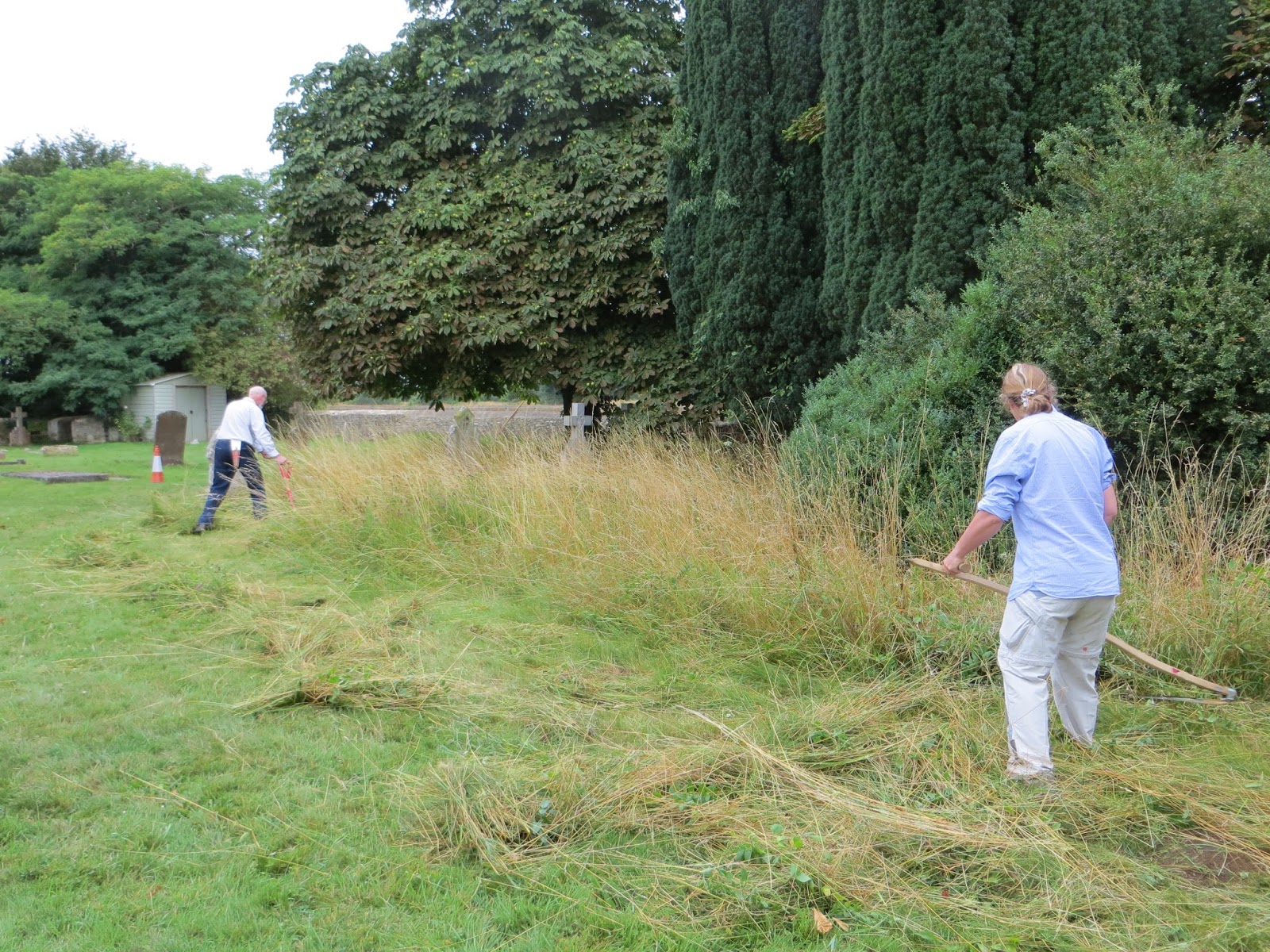
I don't think I could do this all day but according to Jim they only used to scythe early in the morning for a few hours then would spend the rest of the day drying and stacking the hay. Even with the new light weight Austrian scythes a two hour stint was enough for me today. But it is a great form of excercise and can be very satisfying if you can get the rythm and feel of it.
Jim is the most expert of the group. And Morag seemed to be really enjoying herself.
The end result got the approval of some people passing by and the hay went off to feed some very happy horses up the road. Hopefully, next summer Alison's species rich grassland will again be covered in flowers and a home or feeding station for all sorts of invertebrates.
Jim is the most expert of the group. And Morag seemed to be really enjoying herself.
I definitely need more training sessions. If we had a suitable field I would be delighted to organise a course.
Tuesday, 6 August 2013
Geology walk from Stanton Harcourt to the Devil's Quoits
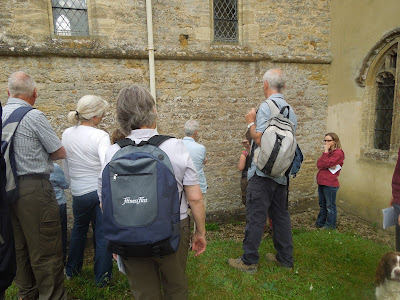
Thanks to Lesley Dunlop from the Oxfordshire Geology Trust we learnt more about the reasons for the shape of the land beneath our feet and where some of the materials in our local buildings came from. Starting from the Harcourt Arms (and ending there for a welcome drink) we visited St Michael C of E church to see the building stones made mainly from oolitic Jurassic limestone and also some made from gravel conglomerate which we were to see again in the stones of the Devil's Quoits. We could also see some fine examples of Stonesfield Slate roofing tiles.
If photographed from a certain angle you would have no idea that this stone circle is right next to a massive landfill site.
One of the newer stones weathering more rapidly with a much more fragmented surface.
At the edge of the village Lesley pointed out the changes in level visible in the view across to Wytham Woods. The variations in the landscape, resulting from the action of the River Thames, are hard to see until pointed out by an expert and as Kathryn emailed me after the walk .....'It gives us so much more of
a sense of history when, for example, we drive up the hill at Linch Hill and
are now aware that it is the division between one gravel terrace and another,
formed by the Thames over thousands of years'.
Walking round the edge of the landfill site along the public footpath to Linch Hill we passed an area of grassland that now has a wealth of wildflowers including common knapweed and ladies bedstraw. This little known footpath then runs alongside an area of dense and scrubby woodland that has grown up naturally in the quarry bottom making an interesting contrast to the newly planted woodland further along by Dix Pit lake.
We then walked alongside Dix Pit which is a huge lake that is now a County wildlife site for birds; gulls and ducks in particular. During the gravel extraction operations much evidence was gathered about previous climatic conditions and palaeochannels from around 200,000 years ago. The excavations revealed over 1000 mammoth remains-tusks, teeth and bones as well as the remains of forest elephant, bison, lion and bear and insects, snails and fresh water molluscs. Twenty six stone tools were also found.
When we got to the Devil's Quoits I was surprised at how many of the group had never visited them before. This henge monument, originally built 4900-4600 years ago, was restored between 2002 and 2008 as a result of the quarrying restoration agreement.
If photographed from a certain angle you would have no idea that this stone circle is right next to a massive landfill site.
By the end of the 19th century there were only three stones left standing but six others were found nearby and nineteen new ones were supplied from the current gravel extraction site at Gill Mill. These new ones are from a very similar strata of conglomerate but they are weathering away much faster than the stones that have been on site for thousands of years. They were formed in slightly different climatic conditions so the cementing sand is less resistant to weathering.
One of the original stones weathering slowly with quite a smooth surface.
This walk will be followed by other walks and talks about a range of topics to do with the environment, wildlife and local history in the Lower Windrush Valley. If you would like to have early notification of future events please email me at jane.bowley@oxfordshire.gov.uk.
Subscribe to:
Posts (Atom)