Monday, 17 March 2014

Part of the Bigger Picture (2)

Don't forget to come and hear Dr Carolyn Jewell talk about the restoration of mineral extraction sites across Europe and in the local area.

 The transition from industrial work site to wildlife haven or recreational setting is happening on our doorstep. Carolyn will describe how some of these developments are making such an important contribution to the conservation of threatened habitat types and species across Europe.

At South Leigh Village Hall at 7.30pm on Thursday 27th March. Parking at the hall is limited so please bring a torch and park down the unlit road in the Mason's Arms, the pub is currently closed but the new owners have given us permission to use their car park.

Clearing up after the floods

The students from Abingdon and Witney College set to with great enthusiam and goodwill as usual to help clear up the aftermath of the flooding around the reedbed. Rolls of wire that we had removed earlier in the winter were stacked up at the edge to make nesting habitat for small birds.  


Then they raked up a huge pile of reed debris that had been washed up by the water.
This area of grassland had a good showing of yellow rattle last summer
so, hopefully, now the debris has been removed it will be able to grow again this year. After lunch they collected several bags of plastic tree shelters, empty bottles and assorted plastic items, old shoes etc that had been dumped by the flood water. They were most fascinated by all the bones they found and thought they might recreate their own animal skeleton.

The Thursday gang also tackled clearing up jobs and had a surprisingly enjoyable and satisfying day. Ian and Colin creating a bit of extra parking space for when the group meets,
 
 
Ian carting all the bags of rubbish that the students had collected back to my car (anyone got a truck going spare?),
Ian putting up some nest boxes
and finding an old coconut, not you this time Ian!

Wednesday, 5 March 2014

Busy week with Poul Christensen and scything (not together)


I don't know where the last week has gone to or even the last month since I managed to put on a post. But last Wednesday a good sized audience gathered at Northmoor to hear Poul Christensen talk about his views about the future of environmental legislation and funding. He was very amusing but gave the serious message that whatever government follows on next year there is unlikely to be any boost to funding for the environment. He proposed that better engagement with business was going to be crucial and said that before he left Natural England companies were ringing to discuss environmental isues as they become more and more concerned about the sustainability of their supply chains.


Poul was clear that local problems would require local action in the future and said that there was plenty of expertise within the audience and there is great potential for the future if we work together. Partnership working was a key theme running through the evning. This was a very timely message for me for the next few months of work in the project. I am now working with consultants from ADAS to develop an up to date strategy for the Lower Windrush Valley Project and will be running a variety of consultation events over the next few weeks to hear what people think. Much has been achieved in the past with one project officer but there is such a potential for more, that if there is the will and people want to join in we could create so many more opportunities.
 
Questions ranged from 'Who is the Project for?' ,' How can we engage futher with businesses?' , 'Will farmers be paid more to hold water on their land?', 'What will be the best way to manage the Windrush catchment in the future?'.
I am very grateful to Poul for what was definitely a lively and interesting and also amusing evening and I hope that people are busy thinking about how we can move forward in the future.
 
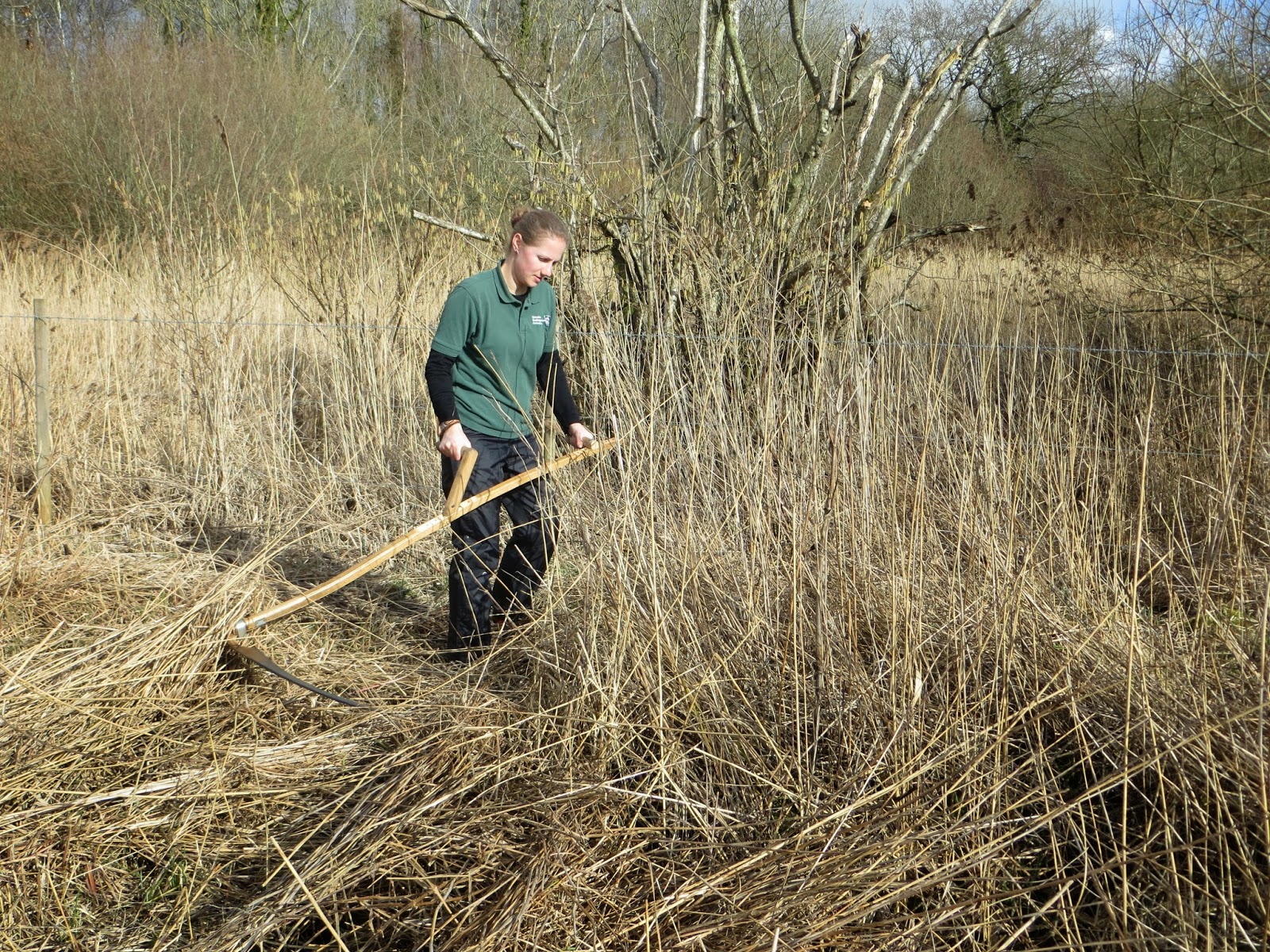
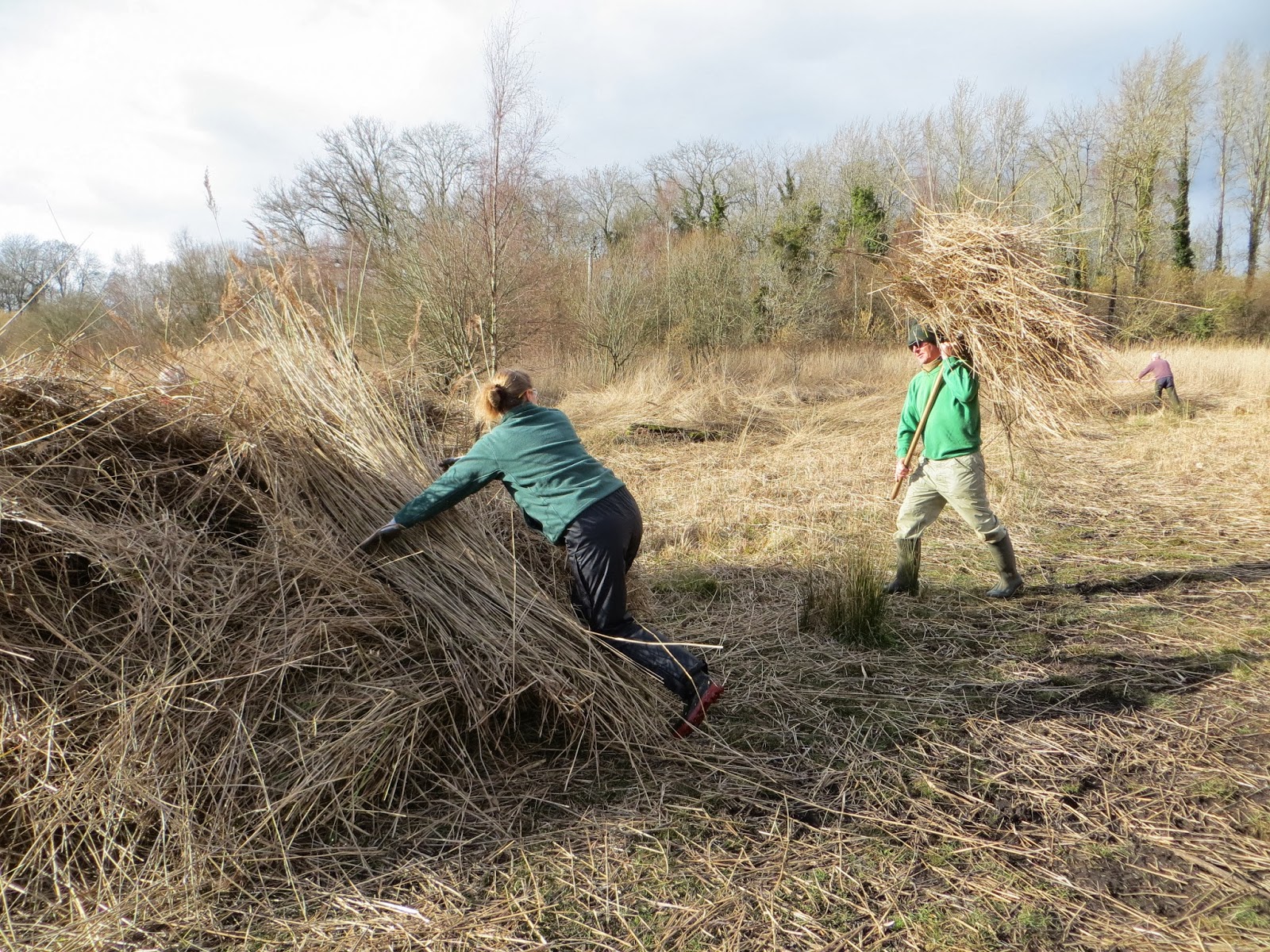
Then as a total contrast I spent Thursday out in beautiful sunshine with the volunteer team training to use scythes in a reedbed. We had planned this as a joint session at Standlake Common Nature Reserve with BBOWT as we share volunteers and I wanted to get some more of the reedbed cleared. But my cunning plan was thwarted by the floods so we went to Parsonage Moor instead and BBOWT got their reeds cleared.
 
 
Training with Clive Leeke http://www.austrianscythes.co.uk/training  whether scything or hedgelaying is always very relaxed but productive and I for one found my technique improved enormously. Some of us found that the addition of a bow to the scythes, made out of a long  hazel twig, made a great improvement as it stopped the reeds poking up your nose and in your eyes, but Elene preferred to use hers without the bow.
 
 
 Sharpening is as much part of the learning process as the actual scything and luckily no one sliced off a finger in the process. We managed to create a huge pile of reeds that will have to be burnt later. And now that everyone is so well trained we should tear through a patch at Standlake next week if the water has gone down enough.


Tuesday, 11 February 2014

Winter valley bird watch 2nd February

Well I did well with the weather; I managed to supply a beautiful bright winter's day, but failed to produce the marsh harrier-will try harder next time. We covered ten different sites across the valley and recorded 67 different species within 273 separate records. My favourites of the morning were the goldeneye at Hardwick Parks  and goldcrest which I guess are always around if you are looking carefully, but I am usually galloping along on one mission or another, so miss these tiny secretive birds. Gill and I were surprised not to have seen a chaffinch all morning then, as we stopped to ponder on the flood of water rushing down the Windrush, we saw not only chaffinch but also a kingfisher. This is probably not the one we saw but it is a great photo that Graham Lenton gave me and is a local bird.


Photo Copyright Graham Lenton
I suppose that is why bird watching is always so tantalising, you never quite know what you are going to see. We all met up for lunch in the hide to share bird stories and tease Keith  and Jon who got the largest list by far as usual, not that we are competitive. The conversation is always far ranging and we covered the delights of the wallcreeper Tichodroma muraria which Graham had just seen on a successful birding trip in France. When I looked it up I realised that I too had seen these amazing birds when I was in the Pyrenees a couple of years ago.
 
There were good numbers and a wide variety of ducks with pochard, red crested pochard, gadwall, teal, wigeon, shoveler and pintail across the main pits. Some interesting records were a grey partridge by Barry and Ian at Rushy Common and the flock of 50 pied wagtail plus chiffchaff by Keith and Jon at Witney Lakes.
 
 Shy bullfinch and photo inside the hide to prove it was sunny.


Anthony told us about the pintail and shoveler numbers at Dix Pit so Gill and I stopped off for another beautiful sight of more than 200 shovelers and 60 pintail in the late afternoon sun, a delightful end to an excellent bird watching day.
 
We will run another valley birdwatch in May so if you would like to join us please let me know on lwvp@oxfordshire.gov.uk


Friday, 7 February 2014

Tree planting

It made a really nice change to plant some trees this week as it is not something we get to do very often. The students from Abingdon and Witney College worked as a happy gang as usual and replaced some trees around the site at Rushy Common.


Then the Thursday team, also a happy gang, put in four native black poplars round Tar Lakes. We put them in near to three old ash trees are looking as if they have not got long left. It will be very satisfying if the black poplars can take over their place as imposing and beautiful trees.
The cuttings were sourced from Aylesbury Vale District Council which, with 50% of the remaining national stock of these very endangered trees, co-ordinates the National Black Poplar Conservation Group. Hopefully, they will successfully add another location for the conservation of these amazingly beautiful trees.


Part of the Bigger Picture


The Lower Windrush Valley Project has been instrumental in many environmental initiatives in the valley over the last twelve years. But this is a time of great change in local and national government policies and administration so it seems like the right time to examine the role of the project now and into the future. The valley is rich in habitat types and wildlife and has great potential for further improvements if there is the interest and the will of local people.
 
 It might be that the decision is to carry on as before which will work fine until the project funding runs out. But there may be more interest from people who can see the potential for a wider remit that will involve more people in the running and operations of the project.

 The next two LWVP talks are aimed at generating as many ideas and suggestions as possible about the future of the project from people who live or work in the area or who have a specific interest e.g as a walker, bird watcher, angler etc. The two talks are focussed on stimulating the debate about the role of the Lower Windrush Valley and the Project in contributing to The Bigger Picture of the county, the country and even the world. I hope that as many people as possible will come to join in with what I am sure will be lively discussions and then to attend a public consultation meeting in May(more details to follow) where we will seek to collate and coordinate views about the future direction of the project.
 
Please pass this information on to anyone you think might be interested so that we can get as wide a representation of ideas as possible.

Wednesday 26th February 7.30 pm at Northmoor village hall

Poul Christensen CBE

Local dairy farmer, President of the National Federation of Young Farmers Clubs and former Chairman of Natural England. Poul will be setting out his view of national trends in environmental issues and management and leading a discussion on how the Lower Windrush Valley may be affected in the future and how we might best work together to face the challenges.


Thursday 27th March 7.30 pm at South Leigh village hall

Dr Carolyn Jewell

Manager of the Nature After Minerals programme. Carolyn will talk about some of the restored mineral extraction sites that are providing valuable habitat for rare and endangered species in the UK and Europe. She will also be covering examples of restoration that we have here in the valley and how they contribute now and may contribute in the future to the Bigger Picture of environmental restoration.


Everyone welcome. For more information about these talks and the consultation please email: Jane Bowley at lwvp@oxfordshire.gov.uk or call on 01865 815426

Wednesday, 29 January 2014

New homes for birds

It has been a busy few weeks since I put up a blog with a lot of office based work towards a new strategy for the project. But I have managed to get out for some practical work. On this joint operation with Witney Town Council staff and the Wychwood Barn Owl group we put up a barn owl box in the Windrush cemetery on Oxford Hill, Witney. The pole was supplied by SSE and  installed by  Witney Town Council.
Pat, Ian and Arthur install and monitor barn owl boxes all over the area. They said this would be a good site with the fields around the cemetery providing good habitat for owls. Other boxes nearby may well supply young owls looking for their own nesting sites in years to come.
Thanks to John and his team there was some skillful work manoeuvering a very heavy and awkward load  then digging the post hole with a rotary attachment on the mini digger.                                                                                                                                                                                      All it needs now is for local owls to move in before the jackdaws find it.
Boxes for the smaller birds like blue tits were also put up in the hedges around the site.