Friday, 20 December 2013

Volunteers love a bonfire

Wherever  possible we try to stack any brash into habitat piles to decompose and provide refuge for invertebrates and small mammals. But the amount arising from the hedgelaying at the Standlake Common Nature Reserve was just too much to dispose of any other way. Volunteers never say no to a bonfire, especially when potatoes and sausages are on offer. The hedgelayers are doing a brilliant job and there will be photos of the completed hedge early next year. 


This huge pile of reeds was also too much to leave lying around. We already have a large amount piled up at the edge of the field in the hope of attracting grass snakes when it gets warmer. Then we will be generating another heap in February when I am hoping to hold a training course for scything reeds if we are not knee deep in flood water. The course will be led by Clive Leeke for LWVP and BBOWT volunteers and staff. Scything is proving to be a very effective way to manage the relatively small areas of reedbed for which we are responsible. It is desirable to cut blocks of reed each year so that there is a diversity in structure across the reedbed, but the cut reed needs to be removed to reduce the amount of nutrient enrichment from the decomposing material. It is always a battle to keep nature at bay and without this management the reedbed would turn into willow carr in just a few years.
We have had reedbunting nesting in the reedbed this year and reed warblers and sedge warblers recorded on site so even this small area is providing some good habitat for these species.


Monday, 16 December 2013

Amazing bird facts and photos

 Dr Graham Lenton brought some amazing facts and his own photographs to illustrate his talk entitled  Why Birds are so Different. These courting albatrosses have a 12' wing span that will carry them for thousands of miles across the oceans. They will dive into the top few feet of the ocean to catch fish and squid and may sit on the suface waiting for the right wind conditions but they only touch down on land for breeding.
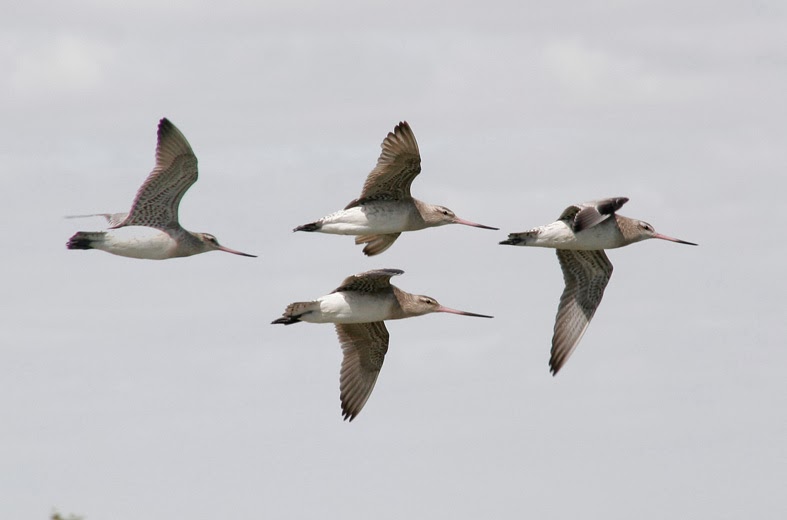
 We are all aware of the extraordinary journeys of many birds like swifts but few of us had heard about the journey of  these bar-tailed godwits. They fly in stages up the east coast of asia from New Zealand to Russia and Alaska to breed, then fly the whole distance, some 7000 miles, back across the oceans in a week without touching land at all. Not surprisingly they arrive back looking very bedraggled and exhausted. They have made such an impression on the local people that when they set off north the bells in Christchurch are rung to celebrate their departure.

 Feet are designed for different purposes and different environments with moorhen feet designed so they can walk on the pond leaves and appear as if they are walking on water. More familiar are ducks webbed feet which are designed to give a larger surface area for paddling; but surely they are not helpful when climbing about on the roofs of houses. Graham also answered a question that is puzzling every time you watch a David Attenborough programme about the Antarctic or the film Happy Feet. Why don't penguins freeze with their feet standing on ice all the time? The answer is that they have a well-designed blood supply system that short circuits just above the foot to send most of the warm blood back to the body and just  enough warm blood round the feet to stop them freezing.
Graham also talked about the differences in bills (or beaks) for accessing different types of food. I am familiar with many differences, for example, birds of prey with their bills designed for gutting and tearing their prey and the seed eating golfinch with fine bills for foraging through the heads of teazels for tiny seeds, but I certainly didn't know that great tits' bills change in shape and size at different seasons of the year. For most of the time they are shorter and stouter for crushing seeds but in the breeding season they become finer and sharper so they can probe into tiny holes to gather the insects that they feed to their young.


Defence mechanisms were another fascinating subject and I won't forget the foul mouthed fulmar in a hurry. Be careful not to get too close to one if the chance arises as it will try to cover you in a foul smelling regurgitated mess.
These are just a few of the amazing bird facts and stories from the talk and as I am writing I remember some more. The kestrel that is really the only bird that can hover although kingfisher and barn owl make a good attempt; the hummingbird that flies backwards with its rotating wings; the fairy tern that is too lazy to make a nest, laying its egg in a tiny indentation on a branch so when the chick hatches it finds itself perched precariously on a twig. There were just too many to mention them all.
Thanks to Graham for a really interesting and enjoyable evening.

Rushy Common bird hide open day

Thanks to members of OOS a very successful open day was held at Rushy Common Nature Reserve on Sunday. They helped lots of new visitors to the hide to use scopes and identify species that, in some cases, they hadn't even heard of before. It was gratifying to find that some people were surprised to see birds that we now take for granted, for example the gadwall. We didn't spot any great rarities but helping someone to see new species or identify the differences between the ducks was satisfaction enough. 'I can't do ducks' was a challenge to the regulars which they willingly tackled. 'I can't do gulls' was maybe best left for another day. Thirty three species were recorded for the day which wasn't bad as I didn't start recording until near the end. We were far too busy talking bird stories, bird facts and bird identification tips, not to mention size of lenses and different types of binoculars and scopes.
Little grebe put on a good show, with seven visible at one time, and seemed to be about the most popular new spot for many people; one person commented that they didn't look like they could float as they look so fluffy. We were pleased to see them as on the valley birdwatch day in May there were no sightings of little grebe for anyone.

 I was particularly pleased to welcome Alexander and Seb back to the hide. They had visited with their class at Stanton Harcourt School in September and were delighted to have the chance to bring their families to have a look. They both bought keys for the hide so I will hope to see them there again in the future.
Watch out for the next bird hide open day sometime in May.
I am going to run another valley birdwatch on 2nd February. If you weren't involved in the first one and would like to join in please contact me at jane.bowley@oxfordshire.gov.uk for more information.

Tuesday, 26 November 2013

December bird watching

I have just been compiling the lists for birds seen at Standlake Common and Rushy Common Nature Reserves in December in previous years. What an amazing variety has been recorded. Great numbers of wigeon and teal and some brilliant rarities; a bittern in 2010 and a hen harrier in 2012 at Standlake. Regular sightings of goosander and pintail can be had at Standlake with goldeneye and shoveler at both sites.  Tufted duck are regulars with pochard and red-crested pochard and lots of great-crested grebe (photos from Graham Lenton) not to mention the mute swans and coot in large numbers.

I tried to count the total number of birds at Standlake last week but got dizzy after 750. If you haven't got a key for the bird hides at these reserves don't forget to come and have a look at Rushy Common on Sunday 15th December when the hide will be open to all from 10.00-4.00. Local enthusiasts will be there to share their knowledge and telescopes and answer questions such as  'How do you count 2463 starlings?' 'What is the difference between a yellow-legged gull and a lesser black-backed gull?' For more information email me at lwvp@oxfordshire.gov.uk

Green cleaning on odd job day


Ian and Colin had an odd job session last week. The first job was to re-hang the fences in the car park that had been nudged over by various vehicles.


 Then we moved on to repair the frame of the interpretation board in the picnic area.


Once that was done Ian used his extensive RAF survival skills training, for making do with what the environment has to offer, as he cleaned the board with a handful of grass. The effect was so brilliant I can now be seen scrubbing boards clean all over the valley

We carried on with coppicing in the mixed thorn and hazel shelter belt in the afternoon. Amazingly the section that we coppiced last winter is regrowing with great vigour despite being under water for nearly three months. The hazel is growing particularly well and this small area has already provided a good number of stakes and binders for the hedgelayers and some good logs for firewood.
 

Friday, 15 November 2013

December Events
 
 
Why are Birds so Different?
talk by Dr Graham Lenton
 at Ducklington Village Hall
Thursday 5th December at 7.30.
 
 
Rushy Common Nature Reserve
Open day at the bird hide
Sunday 15th December
10.00-4.00
Please email:lwvp@oxfordshire.gov.uk to book a place. Local bird enthusiasts will be on hand to share their knowledge and telescopes.
Free entry. No dogs in the hide please.
Car park on Tar Road, Cogges, Witney
SP380074


Escaping the desk

I treasure the days when the outside work coincides with fantastic autumn weather. When I am working with the students from Abingdon and Witney College Pathway Programme as well that is a double bonus. If ever you are feeling jaded with life come and join them; their enthusiasm is infectious. We were continuing with coppicing in the shelter belt along the north shore of Standlake Common Nature Reserve. Some of the students started on this last year but the flooding from November onwards put a stop to any practical work there over the winter.
Dan and Jack were working with saws and loppers for the first time and soon got the hang of it.

 
Dan was particularly pleased to find the remains of a bird's nest.
 
William and Tommy are now experienced coppicers and were delighted with the area that they had cleared together.
 As well as practical skills the students are learning to organise themselves and to work as a team. Collecting and accounting for the tools at the end of the day is an important part of their learning experience.
 
 Then the following day I had another day out with the LWVP volunter group. Colin and Dan had only just cleared two trees that had fallen across the Windrush Path when Ken Betteridge passed by with his Thursday walking group, so we saved them from having to do some hurdling on their way to the Rose Revived. We also carried on with the coppicing which is going to be a long term project over the winter as long as we don't get flooded out again.
You never know quite what you are going to see down on the reserve and as well as the many hundreds of coots, ducks, geese and swans on the lake it was a real joy for us all to end the day with a small murmuration of starlings at sunset. I was at Otmoor on Sunday and although there were much greater numbers there we had a much better display before 'our' couple of thousand birds went down into the reedbed. Small was very beautiful on Thursday.