Wednesday, 29 January 2014

New homes for birds

It has been a busy few weeks since I put up a blog with a lot of office based work towards a new strategy for the project. But I have managed to get out for some practical work. On this joint operation with Witney Town Council staff and the Wychwood Barn Owl group we put up a barn owl box in the Windrush cemetery on Oxford Hill, Witney. The pole was supplied by SSE and  installed by  Witney Town Council.
Pat, Ian and Arthur install and monitor barn owl boxes all over the area. They said this would be a good site with the fields around the cemetery providing good habitat for owls. Other boxes nearby may well supply young owls looking for their own nesting sites in years to come.
Thanks to John and his team there was some skillful work manoeuvering a very heavy and awkward load  then digging the post hole with a rotary attachment on the mini digger.                                                                                                                                                                                      All it needs now is for local owls to move in before the jackdaws find it.
Boxes for the smaller birds like blue tits were also put up in the hedges around the site.


Water Voles in the Windrush Valley

BBOWT Water Vole Project Officer Julia Lofthouse enchanted us with her pictures of these delightful furry animals and told us details about their life cycles and habitats that I am sure I had never heard before.  The water vole in the UK is the same species as in Europe but there they are entirely land based and it is only the british vole that has taken to the water for some reason. Which partly explains why they are not very good swimmers.


Water vole carrying young

 
BBOWT volunteers survey for water voles in the summer looking for their characteristic latrines and the piles of plants that they cut and store ready for eating later. They also make very distinctive burrows in the banks of streams and ditches and you can sometimes see the holes on the surface of the land as well as the paths they make.

 
Numbers have crashed across the country but they seem to be doing reasonably well along the Windrush and across at Chimney Meadows at the moment. Two main reasons would seem to account for the catastrohic decline; firstly the extensive changes in habitat along rivers and streams and secondly, the presence of american mink which are great predators of water voles. The female mink is small enough to pursue the voles into their burrows which is their usual defence strategy. Where good riverside habitat can be maintained and the mink kept to minimum levels the populations of water voles can pick up rapidly. They mature very quickly and they may have up to five litters a year. No wonder their life span may be as short as seven months, although some have been recorded living up to three years.


Abingdon and Witney College students at Rushy Common


The students from Abingdon and Witney College have done a great job coppicing some of the willows in the shelter belt that have grown really fast.


Jack carrying a log to the rapidly growing habitat pile that makes a good seat for William, Dan and Phillip as well.


Battling mud and very wet tree trunks that grip the saw blades like a vice. Who said, 'Where's the chain saw?'


Timber!!!!!!!
That's going to be a good notch, now we're getting the hang of it.


 Good teamwork Tommy, Jack, Dan, Phillip and William.
Now it's time for  relaxation for Stacey and Eileen. Phew it's tough watching those boys work out there.

Friday, 20 December 2013

Volunteers love a bonfire

Wherever  possible we try to stack any brash into habitat piles to decompose and provide refuge for invertebrates and small mammals. But the amount arising from the hedgelaying at the Standlake Common Nature Reserve was just too much to dispose of any other way. Volunteers never say no to a bonfire, especially when potatoes and sausages are on offer. The hedgelayers are doing a brilliant job and there will be photos of the completed hedge early next year. 


This huge pile of reeds was also too much to leave lying around. We already have a large amount piled up at the edge of the field in the hope of attracting grass snakes when it gets warmer. Then we will be generating another heap in February when I am hoping to hold a training course for scything reeds if we are not knee deep in flood water. The course will be led by Clive Leeke for LWVP and BBOWT volunteers and staff. Scything is proving to be a very effective way to manage the relatively small areas of reedbed for which we are responsible. It is desirable to cut blocks of reed each year so that there is a diversity in structure across the reedbed, but the cut reed needs to be removed to reduce the amount of nutrient enrichment from the decomposing material. It is always a battle to keep nature at bay and without this management the reedbed would turn into willow carr in just a few years.
We have had reedbunting nesting in the reedbed this year and reed warblers and sedge warblers recorded on site so even this small area is providing some good habitat for these species.


Monday, 16 December 2013

Amazing bird facts and photos

 Dr Graham Lenton brought some amazing facts and his own photographs to illustrate his talk entitled  Why Birds are so Different. These courting albatrosses have a 12' wing span that will carry them for thousands of miles across the oceans. They will dive into the top few feet of the ocean to catch fish and squid and may sit on the suface waiting for the right wind conditions but they only touch down on land for breeding.
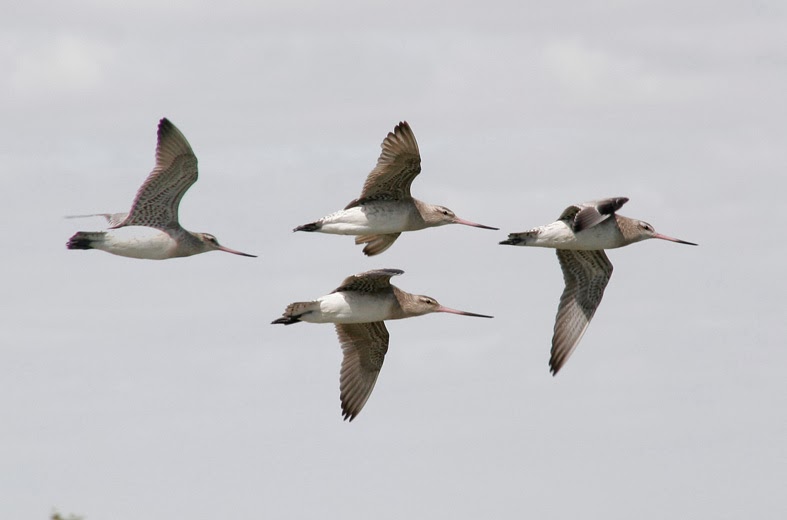
 We are all aware of the extraordinary journeys of many birds like swifts but few of us had heard about the journey of  these bar-tailed godwits. They fly in stages up the east coast of asia from New Zealand to Russia and Alaska to breed, then fly the whole distance, some 7000 miles, back across the oceans in a week without touching land at all. Not surprisingly they arrive back looking very bedraggled and exhausted. They have made such an impression on the local people that when they set off north the bells in Christchurch are rung to celebrate their departure.

 Feet are designed for different purposes and different environments with moorhen feet designed so they can walk on the pond leaves and appear as if they are walking on water. More familiar are ducks webbed feet which are designed to give a larger surface area for paddling; but surely they are not helpful when climbing about on the roofs of houses. Graham also answered a question that is puzzling every time you watch a David Attenborough programme about the Antarctic or the film Happy Feet. Why don't penguins freeze with their feet standing on ice all the time? The answer is that they have a well-designed blood supply system that short circuits just above the foot to send most of the warm blood back to the body and just  enough warm blood round the feet to stop them freezing.
Graham also talked about the differences in bills (or beaks) for accessing different types of food. I am familiar with many differences, for example, birds of prey with their bills designed for gutting and tearing their prey and the seed eating golfinch with fine bills for foraging through the heads of teazels for tiny seeds, but I certainly didn't know that great tits' bills change in shape and size at different seasons of the year. For most of the time they are shorter and stouter for crushing seeds but in the breeding season they become finer and sharper so they can probe into tiny holes to gather the insects that they feed to their young.


Defence mechanisms were another fascinating subject and I won't forget the foul mouthed fulmar in a hurry. Be careful not to get too close to one if the chance arises as it will try to cover you in a foul smelling regurgitated mess.
These are just a few of the amazing bird facts and stories from the talk and as I am writing I remember some more. The kestrel that is really the only bird that can hover although kingfisher and barn owl make a good attempt; the hummingbird that flies backwards with its rotating wings; the fairy tern that is too lazy to make a nest, laying its egg in a tiny indentation on a branch so when the chick hatches it finds itself perched precariously on a twig. There were just too many to mention them all.
Thanks to Graham for a really interesting and enjoyable evening.

Rushy Common bird hide open day

Thanks to members of OOS a very successful open day was held at Rushy Common Nature Reserve on Sunday. They helped lots of new visitors to the hide to use scopes and identify species that, in some cases, they hadn't even heard of before. It was gratifying to find that some people were surprised to see birds that we now take for granted, for example the gadwall. We didn't spot any great rarities but helping someone to see new species or identify the differences between the ducks was satisfaction enough. 'I can't do ducks' was a challenge to the regulars which they willingly tackled. 'I can't do gulls' was maybe best left for another day. Thirty three species were recorded for the day which wasn't bad as I didn't start recording until near the end. We were far too busy talking bird stories, bird facts and bird identification tips, not to mention size of lenses and different types of binoculars and scopes.
Little grebe put on a good show, with seven visible at one time, and seemed to be about the most popular new spot for many people; one person commented that they didn't look like they could float as they look so fluffy. We were pleased to see them as on the valley birdwatch day in May there were no sightings of little grebe for anyone.

 I was particularly pleased to welcome Alexander and Seb back to the hide. They had visited with their class at Stanton Harcourt School in September and were delighted to have the chance to bring their families to have a look. They both bought keys for the hide so I will hope to see them there again in the future.
Watch out for the next bird hide open day sometime in May.
I am going to run another valley birdwatch on 2nd February. If you weren't involved in the first one and would like to join in please contact me at jane.bowley@oxfordshire.gov.uk for more information.

Tuesday, 26 November 2013

December bird watching

I have just been compiling the lists for birds seen at Standlake Common and Rushy Common Nature Reserves in December in previous years. What an amazing variety has been recorded. Great numbers of wigeon and teal and some brilliant rarities; a bittern in 2010 and a hen harrier in 2012 at Standlake. Regular sightings of goosander and pintail can be had at Standlake with goldeneye and shoveler at both sites.  Tufted duck are regulars with pochard and red-crested pochard and lots of great-crested grebe (photos from Graham Lenton) not to mention the mute swans and coot in large numbers.

I tried to count the total number of birds at Standlake last week but got dizzy after 750. If you haven't got a key for the bird hides at these reserves don't forget to come and have a look at Rushy Common on Sunday 15th December when the hide will be open to all from 10.00-4.00. Local enthusiasts will be there to share their knowledge and telescopes and answer questions such as  'How do you count 2463 starlings?' 'What is the difference between a yellow-legged gull and a lesser black-backed gull?' For more information email me at lwvp@oxfordshire.gov.uk