Tuesday, 24 March 2015

A tale of two ponds and two mounds

Rushy Common Nature Reserve is maturing into a fascinating world with a great array of habitats and many species of animals and plants in temporary or full time residence or just turning up from time to time.  Managing the growth of plants and trees is a constant process and this winter with Pascale's (Freshwater Habitats Trust) advice we carried out some clearance work on the two ponds on the far side of the reserve that were becoming over grown with willow Salix spp and reed mace Typha latifolia. Digger Dave is very familiar with this sort of clearance work. He can select out short sections so that there is some change but not major disturbance unless that is what is required, as in this clearance of the edge of one pond. On the other pond he just took out five metre sections leaving the marginal plants for shelter for toads and invertebrates.


Pond before


Pond after: this looks quite severe but the vegetation will soon grow up again and the shallows created will be even better for invertebrates, amphibians and wading birds. Dave also cleared some sections of the ditch especially where brambles were starting to completely cover the water, leaving other sections with the plants in place for dragonflies and damselflies etc in the summer.

Unlike some other gravel pits and nature reserves there are areas of the site that are very high in nutrients causing rapid plant growth and a tendency for nettles to dominate. For several years we have been trying to batter the nettles into submission but this year we are trying a different approach on one of two  mounds of topsoil. One will continue to be mown and sprayed with herbicide but the other has been planted up with berry bearing viburnum shrubs. If successful this will provide a good area for small birds nesting in spring and with berries that will feed birds and small mammals in winter. We might then plant the other mound up in future years. There will still be plenty of areas of nettle for peacock and other butterflies to feed and lay their eggs.


Viburnum planting in the foreground, nettle mound in the background

Great to see coltsfoot  Tussilago farfara about to burst open from a rough and stony patch over a bridge.

Lunching with the Cetti's at the reedbed

The volunteer group have been busy cutting bays into the reedbed to promote regrowth and have a huge stack of reeds to show for it. Sadly they are no use for general thatching and Hill End are not able to take any this year for thatching their iron age style round houses so it all had to be burnt.


Despite us making quite a disturbance one morning we were entertained by a Cetti's warbler  as we sat and ate our lunch. True to form it lurked in the reeds without showing itself but gave us several rounds of its explosive and distinctive call.

Even though everyone is getting really fit with all this practical work we were very glad to have the help of students from Abindgon and Witney College on the final day. They set to with great enthusiasm raking up the reed and even having a go on the scythes. Some of them showed a promising technique but for one it was all too much and he turned into a hamster. Needless to say they all loved the bonfire.


About 350 sq metres of the reedbed were cleared this year and at this rate we should get round the rest of it over the next two years, then start again at the beginning making a seven year cycle. It will be easier next time round as we won't be having to remove the wire and posts of the enclosures that the original reed seedlings were planted into to stop the geese from eating them all. 
The reed buntings are busy setting out their territories and soon the reed and sedge warblers will be joining them for the summer. Thanks to the winter feeding in the feeders by the bird hide the numbers of reed bunting seem to be quite substantial.

Stanton Harcourt School pond

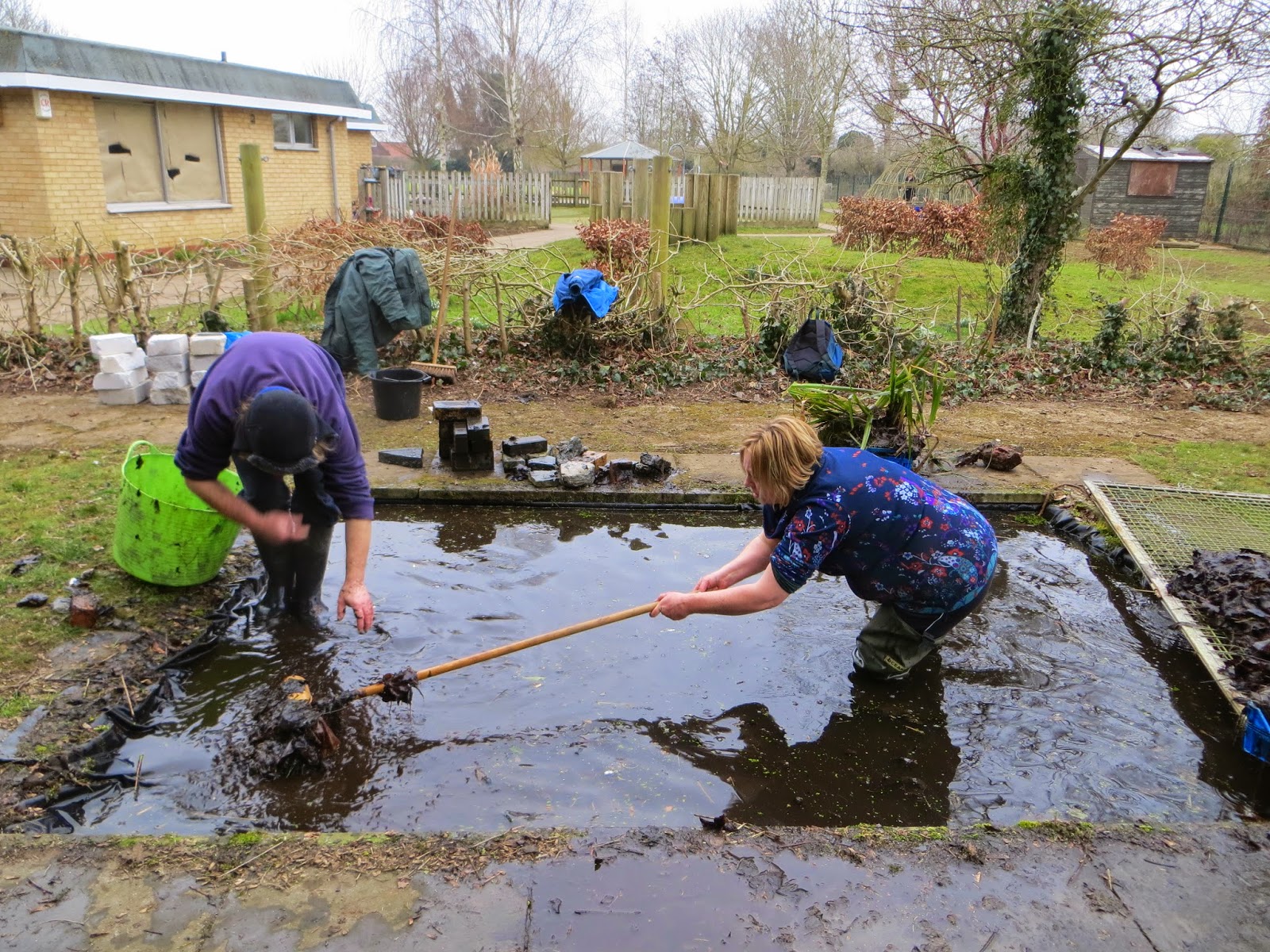
The aim was to turn a rather inaccessible pond into a more child friendly one that doesn't need a heavyweight metal frame to stop children falling in. It seemed a fairly simple plan to fill in the shallower end with gravel to create a bog garden and then there is only half the pond with deeper water to cover. Fortunately Rachel and Chris are made of tough stuff as they cleared some of the mud and leaves from the bottom  and then rigged up a 'wall' across the pond to contain the gravel and their hands and feet went numb from the cold. I had the cushy jobs, as usual, taking photos, collecting blocks from a nearby building site etc.


This well rounded frog decided to evacuate the pond once the gravel started piling in but it didn't have to go far to get some shelter and it went back into the pond before we left.
Rachel has been working hard for several weeks to open up the whole of the pond area, cutting back the hedge, removing a gate and a stile and generally clearing up so that the children can enjoy making much more use of this area.

Many thanks to Smith and Sons Bletchington for the free bag of gravel.


So we managed to reduce the area of deep water and just have to hope that we won't have put off the frogs, toads and newts that were found here last year. A few plants to start things off and the pond area is already starting to look much more welcoming.


Wednesday, 12 November 2014

Safer access to the bird hides

 
Thanks to a great team effort over a few days we have put weld mesh on the boardwalks to the two hides at Standlake and also at Rushy Common. Colin's magic shed supplied us with a pump and with much scrubbing most of the moss, accumulated over several years, was cleared off. The swans, as usual, were not at all worried by all the comings and goings


 Not quite sure how we would have managed without Nigel's expert supervison -"Left a bit Jim, now mind your thumb".

Once fully trained Chris was able to tackle the Rushy Common bird hide all on his own (well almost, there was a field crew and back up team behind the camera of course).
 

Wednesday, 10 September 2014

More kingfishers


Having decided to do more major works, luckily, I met Keith Clack who told me that the kingfishers were sitting on our minimalist posts quite happily. So we just decided to clear the view to the dead branches and leave well alone. Happy kingfisher viewing! If you get any good photos please let me have some for the blog and other publicity.


Tuesday, 2 September 2014

Not all about scything


Scything continues to be a favourite activity with the Thursday volunteers. We have allocated a small area at Rushy Commmon to see if we can create a wildflower area by cutting and removing the cuttings and spreading some wildflower seeds and planting a few suitable plants. There are, of course, masses of wild flowers around the rest of the site but the aim of this patch is to make an area that is attractive to bees and other invertebrates and is visible to visitors to the bird hide.
 
 Chris photographed the only surviving viper's-bugloss plant from our initial planting last year. Red clover, common fleabane, selfheal, purple loosestrife and water mint have already established naturally, providing a good food source for bees, hoverflies and butterflies. We are also going to clear some bare patches and spread some locally sourced seed of yellow rattle, knapweed etc but as you can see below the grass looks very vigorous so it might be a long term project to get the less dominant wild flowers established.


We then went on to create kingfisher perches as requested by several of the birdwatchers. But when we looked on the far side of the hide, where a kingfisher has been seen visiting quite often, we found a network of branches that looked much more interesting than our simple single  branch support. We decided that we were not satisfied with our efforts and this is a work in progress so we are going to have another go this week. Watch this space....and hopefully get good views of the kingfishers in the months to come.


Chris also provided a useful resting place for a very friendly ruddy darter dragonfly.

Pond dippers' delight


You just never know what you might catch when you go pond dipping but with Angus and Sarah on hand there was plenty to find and identify. But Bob preferred to stay in the water he didn't want to sit in  a tray.
Most of us had never seen a water stick insect before
and there were far too many snails-anyone got the garlic butter?
On land there were interesting discoveries to be made as well, including the very rare six-legged umbrella beetle.

And gooey spotty stuff. And masses of  gungey green algae.
 ' Oooh its all slimey and gooey  let me touch it,' said Mabel aged 3.
Our very informal study of Tar Lakes showed that there is a great variety of species already established in the lake. A proper scientific survey will be taking place soon in the Rushy Common lake. The Freshwater Habitats Trust have been carrying out regular surveys which show that Rushy Common is one of the most biodiverse lakes in the valley. It is rated as High Value for its plant richness and rarity attributes and of High or Very High value for macroinvertebrates attributes. The forthcoming survey will show if it has reached maximum diversity or whether new species continue to colonise.